Will California Fall into the Ocean?
No. California is not going to fall into the ocean. Not today, not in a million years. The geology does not work that way.
But the question gets searched thousands of times a month, and the answer matters, because it often leads to a more important one: what can a major California earthquake actually do?
Why California can’t break off
It comes down to fault type. There are three main kinds of faults, and each one moves differently.
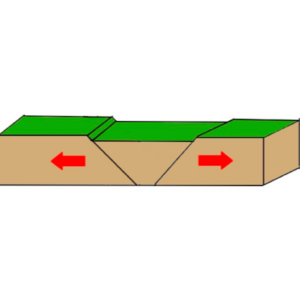
Normal faults occur where the crust is being pulled apart. One side drops down relative to the other as plates move away from each other.
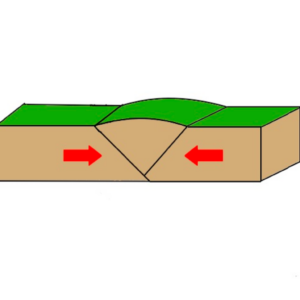
Reverse faults occur where plates push together. One side rides up and over the other.
Strike-slip faults move sideways. The two sides slide horizontally past each other.
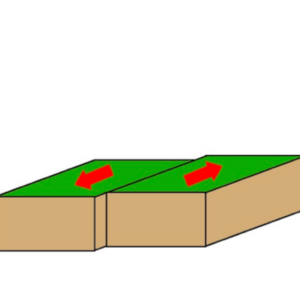
The San Andreas is a strike-slip fault. The Pacific Plate and the North American Plate are grinding past each other laterally, not pulling apart. There is no mechanism for one side to drop away into the ocean. It is physically not possible on this type of fault.
What is actually happening is the opposite of breaking apart. San Francisco and Los Angeles sit on opposite sides of the San Andreas, and they are moving toward each other at about two inches per year, roughly the rate your fingernails grow. In about 15 million years, they will be neighbors.
So California is not going anywhere. But the fault that runs through it is still one of the most dangerous in the world.
What the San Andreas can actually do
The San Andreas Fault last ruptured in a major way in 1906, when a magnitude 7.9 earthquake destroyed much of San Francisco. Over 3,000 people died. The shaking and subsequent fires leveled 80% of the city. If that earthquake happened today, San Francisco would get zero seconds of warning from ShakeAlert because the city sits directly on top of the fault. Facilities further from the epicenter would get a few seconds to a few tens of seconds.
The USGS estimates there is a 72% chance of a magnitude 6.7 or greater earthquake hitting the San Francisco Bay Area before 2043. For Southern California, the Uniform California Earthquake Rupture Forecast puts the probability of a M6.7+ on the southern San Andreas at roughly 60% in the same timeframe.
Those are not guesses. They come from fault slip rates, historical rupture intervals, and the USGS hazard models that seismologists have been refining for decades.
A major San Andreas event would cause widespread damage to buildings, roads, bridges, water systems, and power infrastructure across a large swath of the state. The 1933 Long Beach earthquake, a M6.4 on a different fault, destroyed more than 230 school buildings and killed 120 people. A full San Andreas rupture would be orders of magnitude larger.
What has changed since 1906
California has spent decades building systems to reduce earthquake damage, and it shows.
Seismic building codes, starting with the Field Act in 1933, have made modern construction far more resilient. Hospitals face a 2030 deadline to meet structural seismic standards or close. Retrofit programs have strengthened bridges, overpasses, and older buildings across the state.
And since 2019, California has operated the country’s first statewide earthquake early warning system through ShakeAlert. The system detects the initial P-wave from an earthquake and sends alerts before the damaging S-wave arrives. Depending on distance from the epicenter, that warning can range from a few seconds to over a minute.
For a phone user, those seconds are enough to drop, cover, and hold on. For a facility connected to ShakeAlert through a licensed technical partner, those seconds trigger automated responses: gas valves close, elevators stop at the nearest floor, fire station bay doors open, surgical equipment pauses, PA systems broadcast a warning, backup power activates.
The system works. When a M4.6 earthquake hit Boulder Creek in April 2026, ShakeAlert fired an alert at 1:41 AM, proving it runs around the clock.
What you should actually worry about
California will not fall into the ocean. That is settled science. What is not settled is whether the buildings, facilities, and organizations operating in California are ready for the earthquake that is coming.
The San Andreas will rupture again. Other faults throughout the state will produce damaging earthquakes in the meantime. The San Ramon earthquake swarm has been a reminder of that since late 2025.
The question is whether your facility has systems in place to respond in the seconds before shaking arrives, or whether your earthquake plan is limited to hoping everyone sees a phone notification in time.
To understand how earthquake early warning can work for your specific operation, visit our solutions page.
Sources:
About EWL
Early Warning Labs (EWL) has partnered with the USGS to develop a powerful technology, that gives people time to take cover and creates automated responses for businesses, transportation & machinery to prevent massive damage.